Lec 1:前置知识
基本概念
| English | 中文 |
|---|---|
| set | 集合 |
| element | 元素 |
| union | 并集 |
| intersection | 交集 |
| complement | 补集 |
| mutually exclusive | 互斥 |
| disjoint | 不相交 |
| collectively exhaustive | 穷尽 |
| partition | 分割 |
| random experiment | 随机试验 |
| sample space | 样本空间 |
| event | 事件 |
| even | 偶数 |
| odd | 奇数 |
| independent | 独立 |
| dependent | 相关 |
集合论
-
互斥 (mutually exclusive):
$ \text{A collection of sets }A_1,A_2,...A_n\text{ is mutually exclusive} $ $ \text{if and only if }A_i\cap A_j=\varnothing, i\not=j$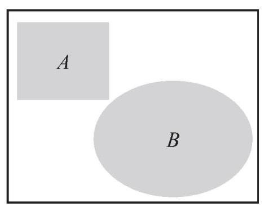
-
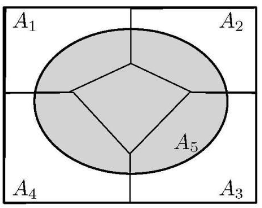
穷尽(collectively exhaustive): $ \text{A collection of sets }A_1,A_2,...A_n\text{ is collectively exhaustive} $ $ \text{if and only if }A_1\cup A_2\cup...\cup A_n=S $
-
分割(partitions):
$ \text{A collection of sets }A_1,A_2,...,A_n\text{ is a partition if it is both mutually} $ $ \text{exclusive and collectively exhaustive} $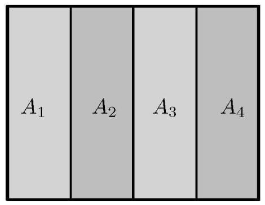
随机试验与概率
- 样本空间(sample space)\(S\):随机试验的所有可能结果的集合
- 事件(event)\(A\):样本空间的一个子集,表示一个特定的结果或结果的集合
- 互斥事件:两个事件 \(A\) 和 \(B\) 互斥,如果它们没有共同的结果,即 \(A \cap B = \varnothing\)
-
独立事件:两个事件 \(A\) 和 \(B\) 独立,一个事件的发生不影响另一个事件发生的概率,即 $$ P(A \cap B) = P(A)P(B) $$
-
相关事件:两个事件 \(A\) 和 \(B\) 相关,一个事件的发生影响另一个事件发生的概率,即 \(P(A \cap B) \neq P(A)P(B)\)
-
容斥原理(inclusion-exclusion principle):
- 对于任意两个事件 \(A\) 和 \(B\),有 $$ P(A \cup B) = P(A) + P(B) - P(A \cap B) $$
- 对于任意三个事件 \(A\)、\(B\) 和 \(C\),有
$$
P(A \cup B \cup C) = P(A) + P(B) + P(C) - P(A \cap B) - P(A \cap C) - P(B \cap C) + P(A \cap B \cap C)
$$
-
条件概率(conditional probability)\(P(A|B)\):
在事件 \(B\) 已经发生的条件下,事件 \(A\) 发生的概率(前提是 \(P(B) > 0\) ),定义为 $$ P(A|B) = \frac{P(A \cap B)}{P(B)} $$
-
全概率公式(law of total probability):
如果 \(B_1, B_2, ..., B_n\) 是一个分割样本空间的事件集合,那么对于任何事件 \(A\),有
$$ P(A) = P(A|B_1)P(B_1) + P(A|B_2)P(B_2) + ... + P(A|B_n)P(B_n) $$
-
贝叶斯定理(Bayes' theorem):
如果 \(B_1, B_2, ..., B_n\) 是一个分割样本空间的事件集合,并且 \(P(B_i) > 0\) 对于所有 \(i\),那么对于任何事件 \(A\),有 $$ P(B_i|A) = \frac{P(A|B_i)P(B_i)}{P(A|B_1)P(B_1) + P(A|B_2)P(B_2) + ... + P(A|B_n)P(B_n)} $$
书写规范
- 用大写字母表示随机变量,如 \(X\)、\(Y\)、\(Z\) 等
- 用小写字母表示随机变量的取值,如 \(x\)、\(y\)、\(z\) 等
- 用 \(S\) 表示随机变量的取值范围,如 \(S_X\) 表示随机变量 \(X\) 的取值范围